
HubSpot UNBOUND 2026: The Full Recap for Marketing, Sales and Customer Service Teams
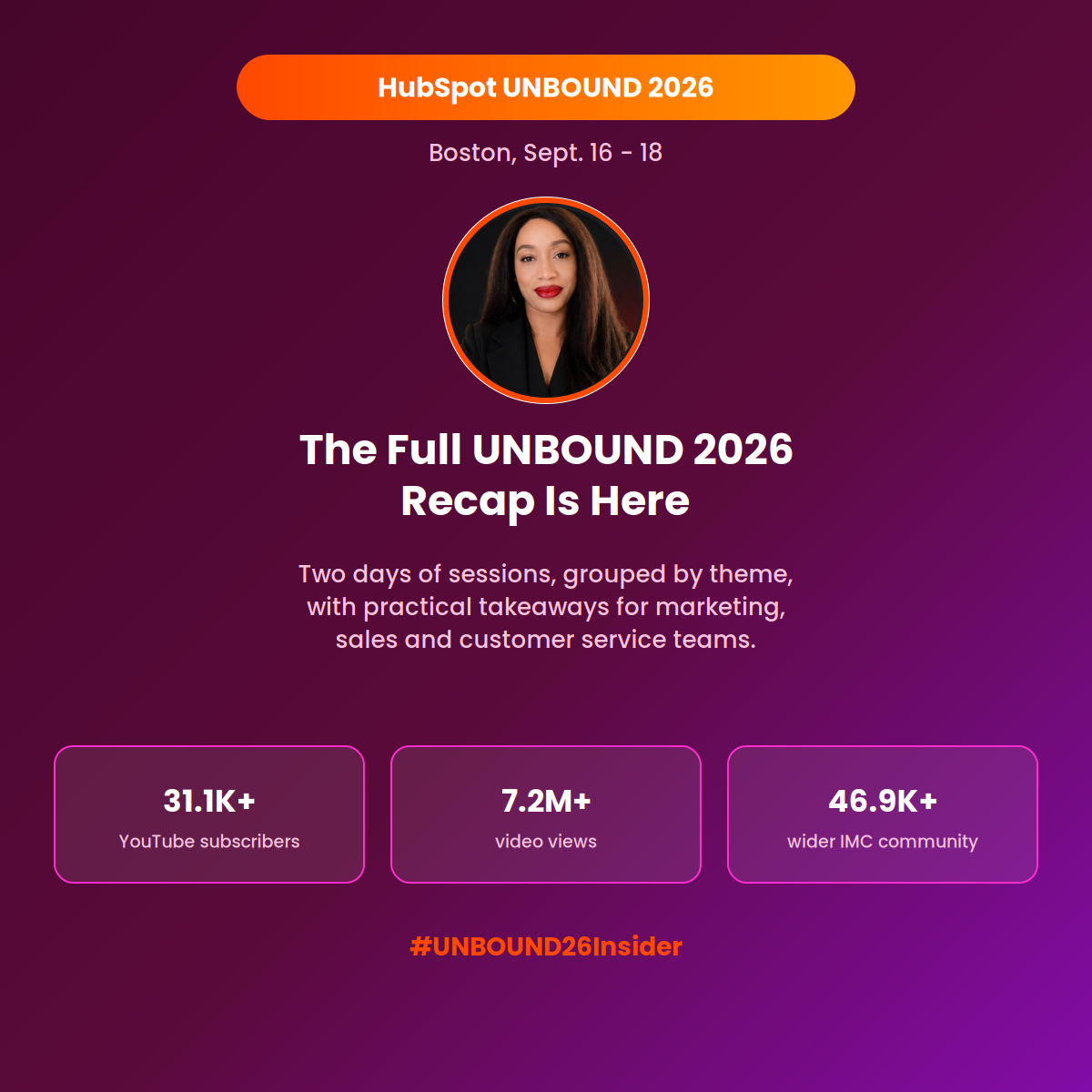
Two days in Boston. Dozens of sessions. One clear signal running through all of them: AI now touches every stage of revenue, but the tools alone are not the advantage. The advantage comes from what sits underneath them, clean systems, sharp positioning and human judgment.
This is the full recap IMC promised for the fast growing IMC community of over 46.9K (up to the 29th September 2026), organised by theme rather than by session order, with a breakdown of what each insight means in practice for marketing, sales and customer service teams.
The Big Picture
HubSpot CEO Yamini Rangan opened by naming what most of us are quietly feeling, AI adoption has become exhausting rather than empowering. Workloads have tripled as teams max out on tools, models and agents without a clear return. Survey data from 6,000 companies backed this up. AI use is now nearly universal, yet only 6 percent of companies report transformational results.
The businesses in that 6 percent share one habit. They resist chasing every use case and instead pick a small number tied directly to enduring outcomes, building demand, winning deals, and retaining customers. Across 50 tracked AI use cases, top performers typically focus on only four or five per motion. The common generative tasks everyone talks about, content drafting, email writing, meeting prep, are widely used but deliver comparatively low value. The real gains come from context heavy, analytical work that competitors cannot easily copy.
This is the thread that ran through every session across both days. AI does not create advantage on its own. Trustworthy data, clear systems and disciplined focus do.
AI, Search and Discovery Are Being Rewritten
B2B buying has moved from sales led education, to inbound content, to peer channels like Reddit and TikTok, and now to AI search inside tools like ChatGPT and Claude. Buyers are vetting ads and cold outreach inside AI conversations, and sometimes choosing vendors they had never heard of before the AI recommended them.
This shift has a name, Answer Engine Optimisation, or AEO. Classic SEO rewarded pages built for clicks. AEO rewards pages built to be cited, ones that answer specific questions directly, expose structured FAQs and schema, surface proprietary data, and stay fresh and consistent across every channel. Several sessions described this as building a canonical knowledge layer for both humans and machines, rather than chasing brittle prompt level metrics.
On the paid and outreach side, the same logic applies to Connected TV. B2B deals typically involve up to 16 stakeholders, yet most Account Based Marketing only targets the two or three people who click. CTV extends reach to the full buying committee and builds the brand recognition, the halo effect, that makes every other channel convert better once people already recognise your name. A four step workflow was shared for this, plan the ICP list and enrichment, resolve identities to households, run self serve campaign delivery, then measure completion, attribution and incrementality. It turns a static account list into a targeted TV audience without needing an agency.
What this means for marketing teams: structure content to answer specific buyer questions directly, not just to rank. Document case studies, use cases and proof points so AI tools have something concrete to cite. Treat AEO as a growth channel in its own right, not an SEO afterthought.
What this means for sales teams: buyers may already have formed an opinion of your brand, and your competitors, before a rep ever speaks to them. Assume more of the buying committee is aware of you than your CRM shows, and less aware than you assume if your content has no AI visibility.
What this means for customer service teams: the same trust signals that influence AI recommendations, clear documentation, consistent answers, visible proof, also shape how existing customers perceive support quality. Consistency across channels is no longer optional.

CRM as the Real Growth Engine
Several sessions reframed CRM entirely, from a static database to what one speaker called a dynamic "growth context" engine, unifying signals, documenting intent, powering agents, and surfacing recommendations tied directly to revenue and pipeline.
The data behind this was blunt. Roughly 80 percent of data questions inside a business are routine and self servable, freeing data teams for the 20 percent of work that actually drives growth, but only if the underlying data is clean and governed first. Email reinforced the same point from a different angle, around 28 percent of email lists decay every year, and only 62 percent of incoming addresses are even valid on entry. Email remains the highest ROI channel available, but only for businesses that validate and clean data continuously.
This is precisely the gap the IMC CRM Audit Tool exists to close, running a full audit across companies, contacts and deals in 1 to 15 minutes and producing a report with direct links to every affected record.
AI compounds this problem or this advantage, depending on which side of clean data you sit on. Speakers were direct about this. AI operating on bad or outdated context does not just underperform, it misroutes approvals, miscalculates metrics, and can perform worse than having no AI at all. Transformational companies invest first in accurate data and dynamic context, covering brand, products, customer history, intent signals and internal processes, so AI behaves like an expert rather than a generic assistant.
What this means for marketing teams: segmentation, personalisation and AI generated content are only as good as the CRM data feeding them. A campaign built on stale contact data will underperform regardless of how good the creative is.
What this means for sales teams: forecasts and lead scoring built on dirty CRM data cannot be trusted, no matter how sophisticated the AI model behind them. Data hygiene is now a revenue function, not an admin task.
What this means for customer service teams: retention and expansion depend on an accurate, current view of the customer. Automating the repetitive is valuable, but the relationship still runs on trust and human judgement, not on a model working from outdated records.
Agents, Automation and Where Each One Belongs
HubSpot's Breeze Assistant was framed around a shared Context Home, where teams and agents draw on the same data and brand identity. Describe an outcome, and Breeze builds the plan, then turns it into shareable artifacts, briefs, reports and portals.
A separate deep dive on building AI agents drew a clear line between three different things that get conflated constantly. Chatbots answer prompts in a fixed way with no autonomous tool use. Automations follow predetermined multi-step workflows that can call tools but still obey fixed logic. Agents choose their own steps and tools, adapting dynamically to reach a goal.
The guidance on when to use which was equally clear. Build an agent only when a task has many valid paths, unclear upfront steps, verifiable outputs, reversible errors and enough volume to justify it. Fixed, sensitive workflows with high, irreversible risk are better served by deterministic automation plus a human approval gate. Robust agents also need precise system prompts defining identity, objectives, boundaries and escalation rules, clearly described tools, and ongoing evaluation and observability to catch wrong tool selection, degradation on long runs, and hallucinated data before they cause damage.
A related session on scaling AI across a marketing team put it plainly, AI only creates value when pointed at a clearly defined business gap. Teams were urged to identify what is not happening in the business, why, and then design AI assets specifically to close that constraint, rather than adopting AI broadly and hoping value follows.
What this means for marketing teams: before adopting another AI tool, define the specific workflow gap it closes. A shared Context Home style approach, one source of truth for brand and data, prevents every team member's AI output from drifting in a different direction.
What this means for sales teams: use agents for high volume, reversible tasks like research and follow-up sequencing. Keep human approval gates on anything irreversible, like contract terms or pricing exceptions.
What this means for customer service teams: automation should absorb the repetitive and predictable. Escalation paths and judgement calls stay human, particularly where a wrong decision cannot easily be undone.
Trust, Belonging and the Human Layer
Several sessions pushed back directly against the assumption that AI scale can replace relationship building. The message was consistent, brands must design deliberately for belonging, transparency and human-in-the-loop decisions to avoid what one speaker bluntly called "AI slop", generic, forgettable content that erodes trust rather than building it.
Leadership themes carried the same thread. Mel Robbins spoke about leading with intention, asking constantly what you are doing, why, who it is for, and what it is for. She described leaders as people who "bring the weather", their energy sets the emotional conditions for everyone around them, and effective leaders stay calm, define what success looks like, and give candid feedback that signals both high expectations and genuine belief in people's ability to meet them. Her practical tools, the "let them" theory and the five second rule, both exist to interrupt hesitation and self-doubt before it stalls a decision.
Cynthia Erivo's closing conversation reinforced the same idea from a creative angle, intentional planning, choosing work that demands everything of you, and treating obstacles as a reason to adjust pace rather than quit.
What this means for marketing teams: personal branding, founder visibility and genuine thought leadership are becoming durable differentiators precisely because AI generated content is making generic brand messaging easier to spot and easier to ignore.
What this means for sales teams: trust is still built person to person. AI can prepare a rep brilliantly, but it cannot replace the judgement calls that close a relationship-based deal.
What this means for customer service teams: belonging and consistency compound over time. A customer who feels like a number to an automated system churns, no matter how fast the automation responds.
Global Expansion and Structural Fundamentals
A session on international growth was a useful reminder that not every challenge in this new landscape is an AI problem. Choosing the right market is only step one, culture and relationships close deals, particularly in markets like Brazil and Mexico. Structure, FX planning and a consistently applied brand identity are what keep international operations working once the initial market entry excitement fades.
What this means for all teams: AI is reshaping discovery and workflow, but fundamentals like market fit, operational structure and financial planning have not gone anywhere. Do not let AI strategy crowd out the basics.
Closing Thought
Across both days attended by Alberte Touani, a HubSpot UNBOUND Insider, the founder of the IMC community and the builder of the IMC CRM Audit Tool, the pattern was the same whether the topic was AI agents, CRM data, content strategy or leadership. The tools arrive for everyone at the same time. The advantage comes from what a business does with clean data, clear positioning and disciplined human judgement underneath those tools.
If your team is unsure where your own CRM data stands on that spectrum, that is exactly what the IMC CRM Audit Tool was built to answer, a full audit of your companies, contacts and deals in 1 to 15 minutes, with a report linking directly to every affected record. The first report is free during the launch period.
Book a free consultation to discuss where your team's biggest gap sits or how the IMC CRM Audit tool (now available on HubSpot App Marketplace) can identify some of the data issues showing in your HubSpot CRM data in less than 1 to 15 minutes, and we will work through it together.
To join the IMC community, follow the founder on LinkedIn, IMC on Facebook or IMC on YouTube.